


The Real AI Model Story Is About How Open-Weight vs Closed-Weight Model Prices Performance Evolves
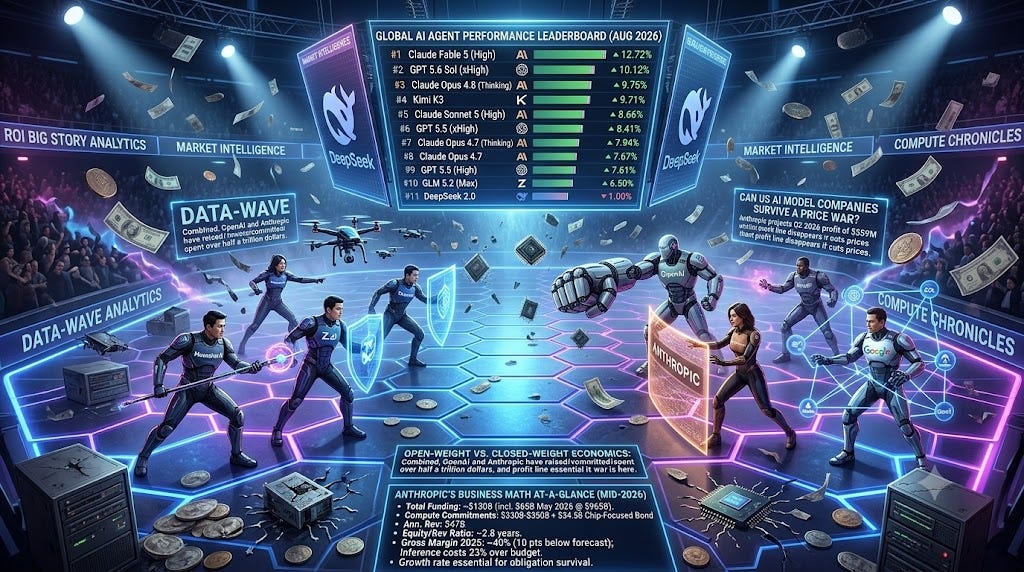
According to The Information, Anthropic is projecting its first-ever quarterly operating profit of $559 million in the second quarter of 2026. If it cuts prices to match competing open-weight models from China, that profit line disappears almost immediately and won’t be back any time soon. That’s a big issue if open-weight AI model companies launch a price war against the leading frontier AI model companies.
The term “Closed-Weight” is evolving to replace what has traditionally been called “Frontier Models”. Closed-Weight models keep their parameters private, and you can only access them through an API or user interface. Open-Weight models publish their trained parameters for anyone to download, run, and fine-tune on their own infrastructure.
The Business Math of Closed-Weight AI Model Companies
Three US AI labs are the leaders in frontier models: Google, OpenAI, and Anthropic. Google’s AI capabilities are infused in almost all its products, so it’s hard to analyze Google’s AI-specific economics. However, based on Google’s latest earnings report, which showed blowout growth in its cloud + AI business, it’s safe to say that its AI business is profitable, so Google gets a pass. Its business math is getting better every quarter.
Anthropic and OpenAI are another story. Combined, OpenAI and Anthropic have raised, committed, or spent well over half a trillion dollars getting here.
Anthropic’s Business Math
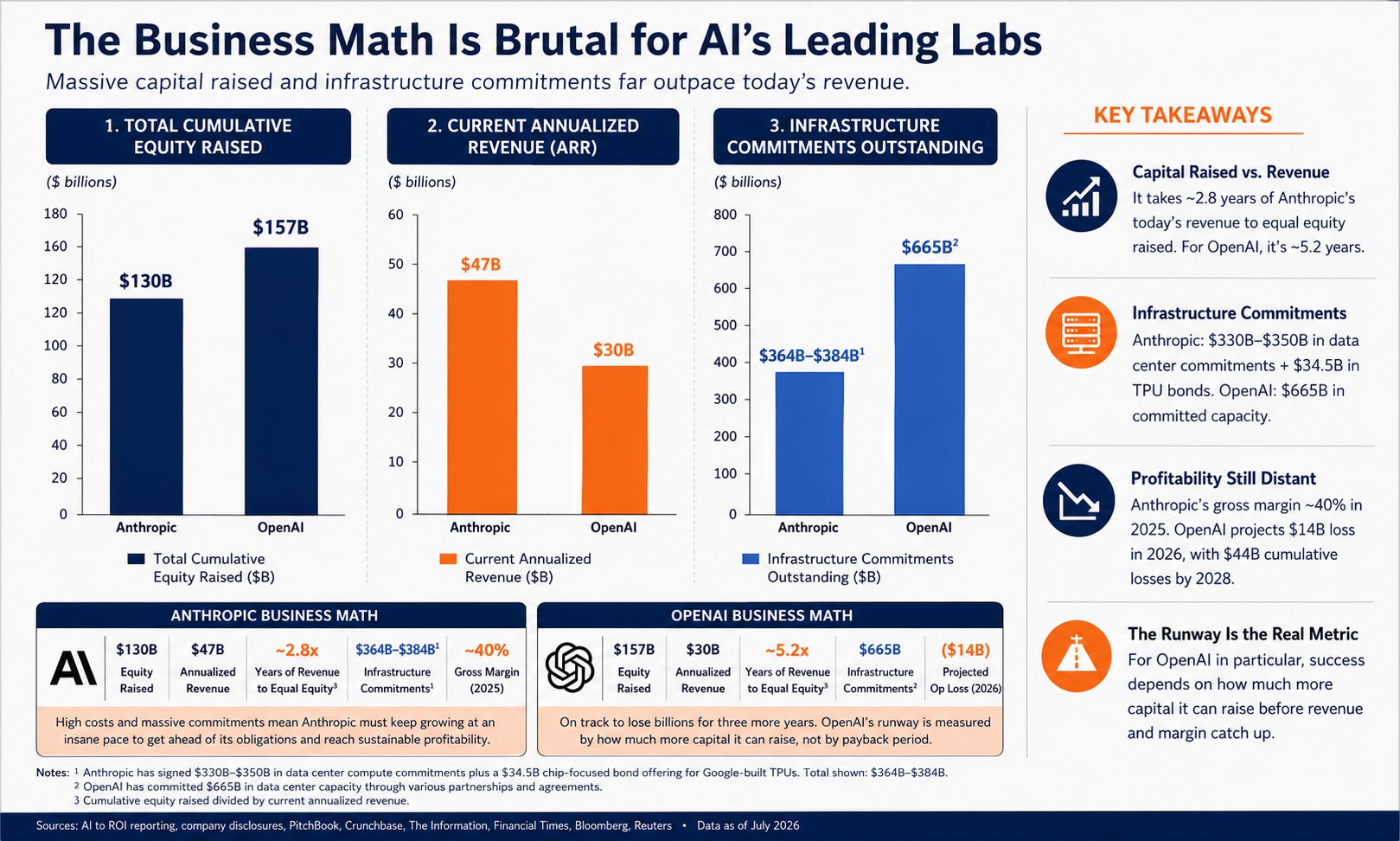
Anthropic has raised roughly $130 billion across its funding history, most recently $65 billion in a May 2026 Series H that valued the company at $965 billion.
Anthropic has also signed $330 billion to $350 billion in data center compute commitments and issued a separate $34.5 billion chip-focused bond offering to pay for Google-built TPUs.
Anthropic’s annualized revenue hit $47 billion in mid-2026, up from roughly $9 billion at the end of 2025.
Divide cumulative equity raised by current annualized revenue, and it takes about 2.8 years of today’s top line revenue to equal the equity raised to date. That doesn’t factor in the company’s compute commitments.
Plus, Anthropic has very high operating costs. Its gross margin was near 40% in 2025, 10 points below Anthropic’s own forecast, driven primarily by inference costs that were 23% over budget.
To stay ahead of its obligations, Anthropic needs to continue growing at an insane pace, and it’s hard to say for sure when It will deliver consistent, growing profitability.
OpenAI’s Business Math
In its most recent round, OpenAI raised $122 billion at an $852 billion valuation. The company has raised $157 billion in total.
Annualized revenue sits near $30 billion.
OpenAI has committed to purchasing $665 billion in data center capacity and projects a $14 billion non-GAAP operating loss in 2026, with cumulative losses reaching $44 billion by 2028 before a projected profit in 2029.
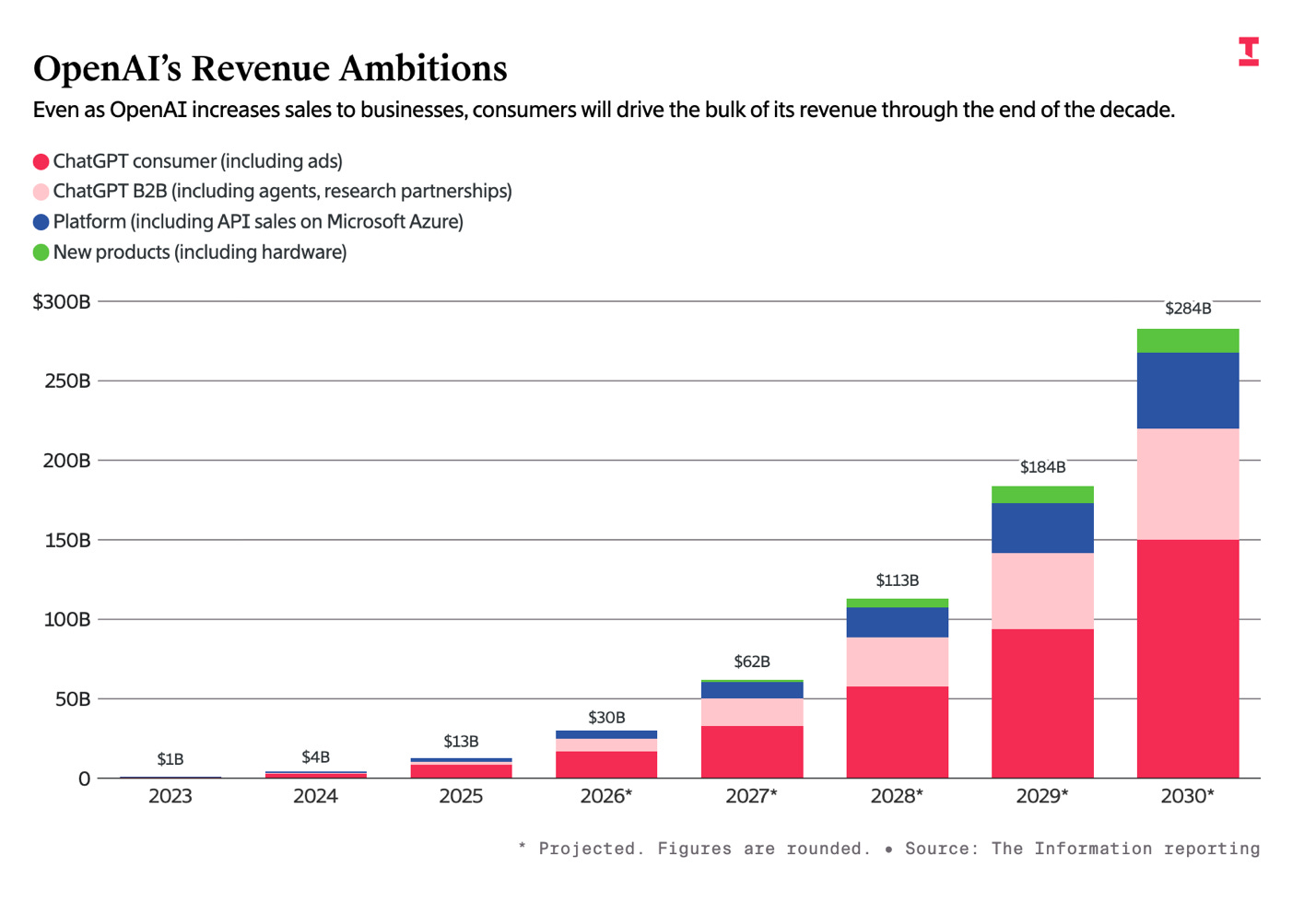
As of the end of 2025, OpenAI projected $184 billion in revenues in 2029 and $284 billion in 2030, with gross margins rising to 69% by 2029.
This business model assumes that OpenAI will build a $100 billion ad business by 2030; however, that business is off to a very slow start. So far, advertisers aren’t impressed with OpenAI’s AdTech systems.
OpenAI is on track to lose billions for at least three more years, so it does not really have a meaningful payback period. It has a path forward driven by how much more capital it can raise to fund operations, build out massive amounts of compute, and meet other contractual obligations. If Anthropic needs to grow at an insane pace, OpenAI needs to grow at a mega-insane pace and rapidly drive down operational costs.
The Business Math of Open-Weight Labs Is the Same Playbook, but With Less Access to Capital
At least seven companies building open-weight models can credibly compete against the closed-weight, frontier AI models: DeepSeek, Z.ai, Moonshot AI, MiniMax, Mistral, Thinking Machines, and Reflection AI. Four of these companies have released sufficient financial data for us to compare their business metrics with those of OpenAI and Anthropic.
Before we do that, however, let’s make one thing perfectly clear:
So far, the business math for the open-weight model companies is also terrible.
To quote Business Insider:
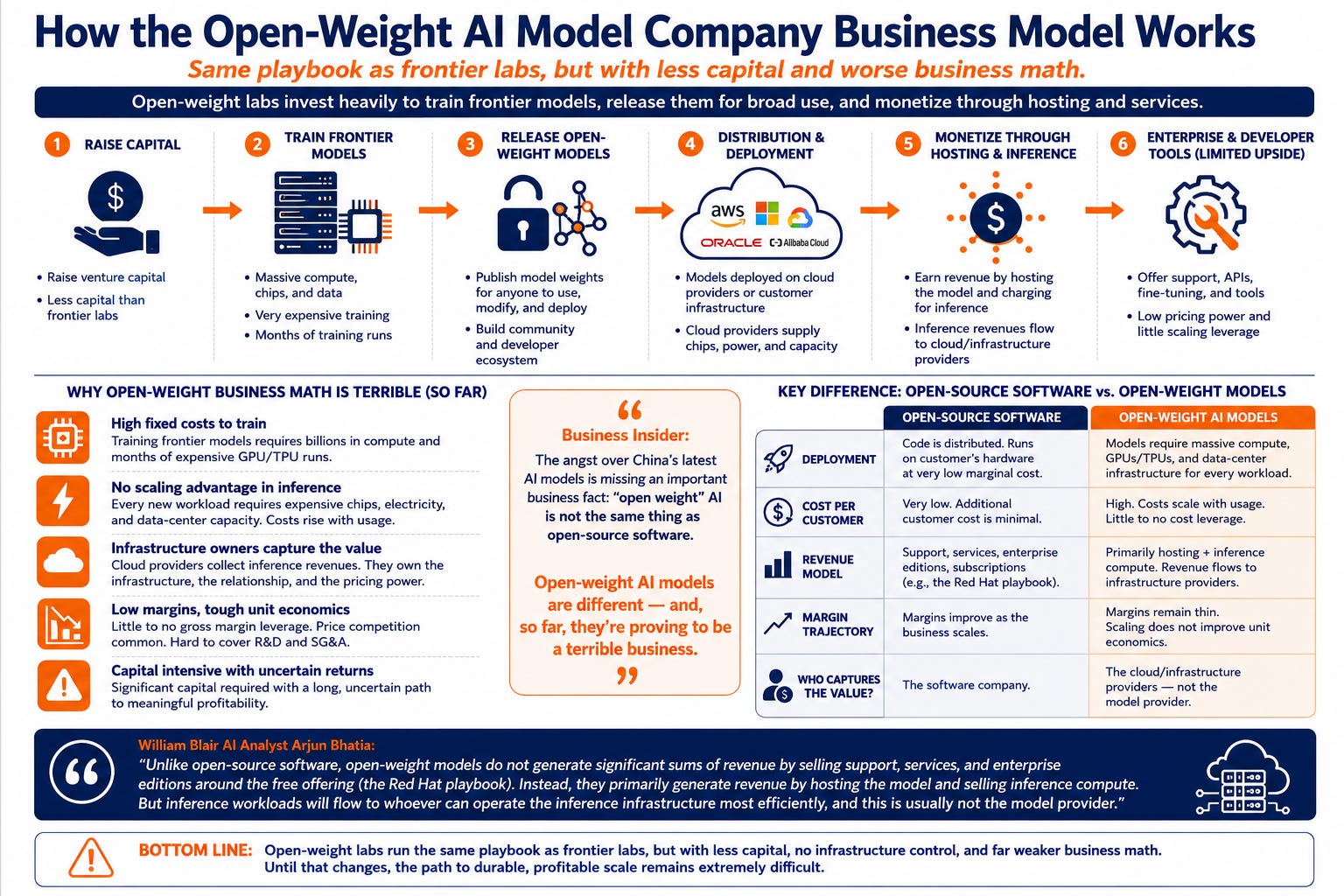
The angst over China’s latest AI models overlooks an important business fact: “open-weight” AI is not the same as open-source software. Open-source software, where code is freely shared, can be an amazing business model. Think Red Hat, which IBM bought for $34 billion.
Open-source software can be delivered at very low cost, and adding customers is also very low-cost. Profit margins improve as open-source software companies grow.
Open-weight AI models don’t work that way. Every new workload requires expensive chips, electricity, and data-center capacity. When you add a new customer, costs keep pace. There are few scaling advantages.
To make things worse, like their closed-weight competitors, open-weight model makers invest heavily in training their models to achieve high performance. In production, the models are either deployed on cloud platforms run by Amazon, Microsoft, Google, Oracle, Alibaba, or a specialist provider, or run by the customer on internal systems. Cloud providers collect most of the inference revenues, not the open-weight model makers.
To quote William Blair AI Analyst Arjun Bhatia:
“Unlike open-source software, open-weight models do not generate significant sums of revenue by selling support, services, and enterprise editions around the free offering (the Red Hat playbook). Instead, they primarily generate revenue by hosting the model and selling inference compute. But inference workloads will flow to whoever can operate the inference infrastructure most efficiently, and this is usually not the model provider.”
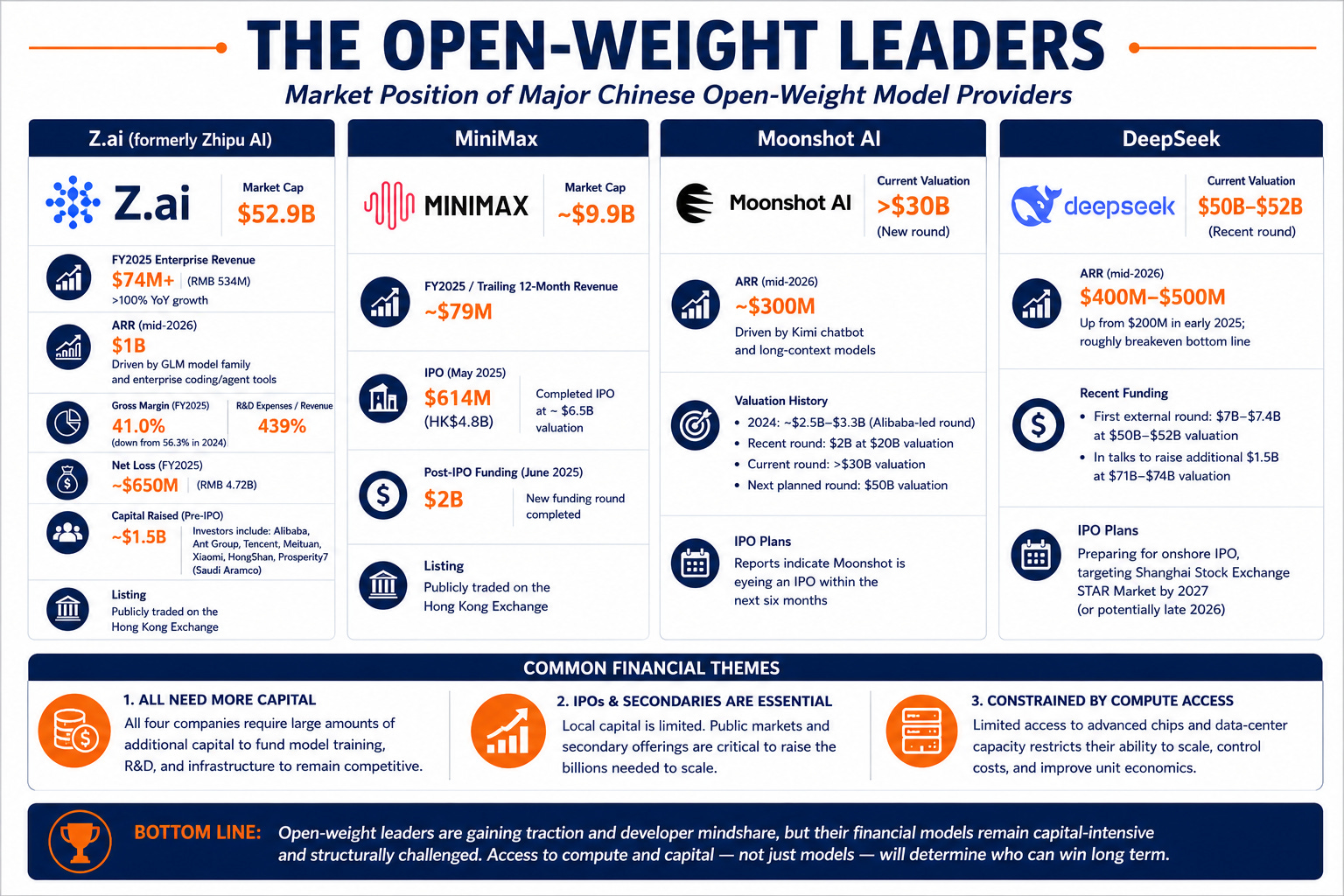
The Open-Weight AI Model Leaders
Let’s look at the financial position of the major Chinese open-weight model providers:
Z.ai (formerly Zhipu AI)
Is publicly traded on the Hong Kong Exchange. It’s China’s first publicly listed pure-play AI company.
The company generated over 734 million yuan (~$100M) in on-premises and enterprise deployment revenue in FY2025, representing >100% YoY growth with ~48.8% gross margins.
Z.ai’s ARR reached $1 billion in annualized revenues by July 2026, propelled by developer adoption of its GLM model family (such as GLM-5.2) and enterprise coding/agent tools.
Overall gross margin was 41.0% (down from 56.3% in 2024, reflecting the higher mix of lower-margin cloud deployment revenue).
R&D expenses equaled 439% of total revenues.
The company’s net loss hit RMB 4.72 billion (~$650M USD).
Z.ai raised roughly $1.5 billion across private rounds prior to its IPO. Early investors include Alibaba, Ant Group, Tencent, Meituan, Xiaomi, HongShan, and Prosperity7 (Saudi Aramco).
Z.ai’s market capitalization is $52.9 billion – about 50x its current annualized revenues.
MiniMax
Is publicly traded on the Hong Kong Exchange.
Trailing 12-month / FY2025 revenue reached ~$79 million USD.
Completed a $614 million (HK4.8B) Hong Kong IPO at a ~$6.5 billion valuation.
Recently followed up with a $2 billion post-IPO funding round.
MiniMax market capitalization is ~$9.9 billion.
Moonshot AI
Moonshot is currently generating an estimated $300 million in Annual Recurring Revenue (ARR), driven by adoption of its Kimi chatbot and long-context models.
The company was valued at ~$2.5B–$3.3B in 2024 following an Alibaba-led round. It subsequently raised $2 billion at a $20 billion valuation and is currently finalizing a new funding round at a >$30 billion valuation, with another round valued at $50 billion planned.
Reports indicate Moonshot is eyeing an IPO within the next six months.
DeepSeek
DeepSeek was originally self-funded by founder Liang Wenfeng’s quantitative hedge fund, High-Flyer.
DeepSeek has reached $400-500 million in ARR, up from $200 million in early 2025 with a roughly breakeven bottom line.
DeepSeek recently closed its first external round of $7B–$7.4B at a $50B–$52B valuation. It is currently in talks to raise an additional $1.5 billion at a $71B–$74B valuation.
DeepSeek is preparing for an onshore IPO, likely targeting the Shanghai Stock Exchange STAR Market by 2027 (or potentially late 2026).
There are common financial themes across these four companies:
All four need access to substantial additional capital to compete.
Since the large US tech investors are not allowed to invest in Chinese companies, the Chinese public markets, government agencies, sovereign wealth funds, and large Chinese tech companies (sometimes with competing interests) are the best funding options.
Their business models are constrained by a lack of access to compute resources.
Barring extreme support or coercive direction from the Chinese government (which has happened in other industries), there isn’t an incentive to start an AI price war.
In fact, open-weight providers have an incentive to raise prices closer to closed-weight frontier model levels to juice growth, not create a downward pricing spiral.
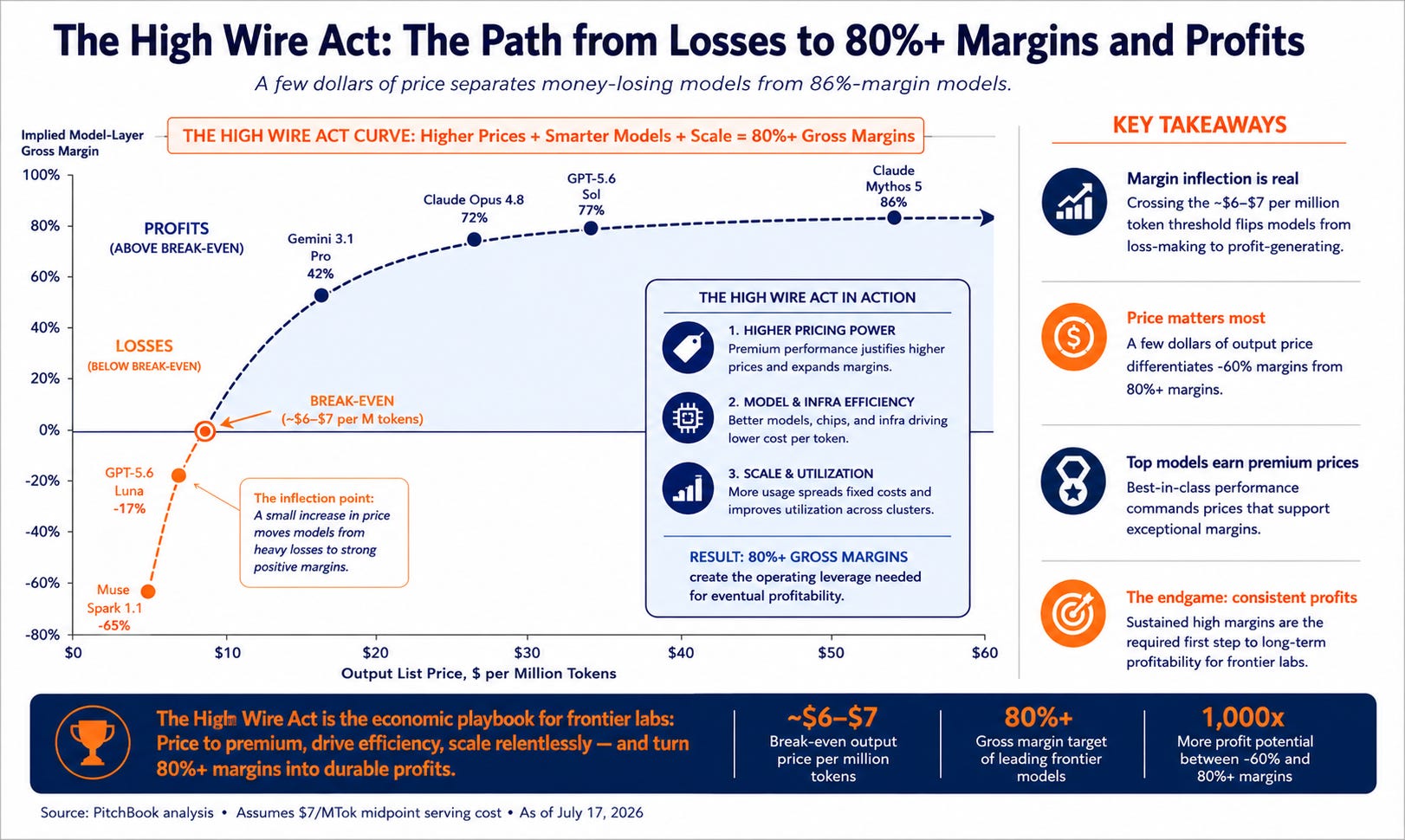
The Closed AI Frontier Model Company High Wire Act
The big fear in the AI industry is that a price war will erupt and closed-weight model companies will be forced to lower prices to open-weight model levels. The effects of a price war would be brutal for OpenAI and Anthropic. Let’s do some math:
A frontier model serves tokens at a cost of roughly $6 to $8 per million output tokens.
At Anthropic’s $25 output price for Opus 4.8, that is about a 70 percent gross margin.
At the $4 to $6 floor where Meta’s Muse Spark and OpenAI’s GPT-5.6 Luna sit, margin turns negative, roughly ~17 percent at $6 and ~65 percent at $4.25.
A 4x to 5x price cut in one generation outruns the 2x to 3x serving-cost decline that each hardware generation typically delivers.
Note that Chinese open-weight model prices are lower than Meta Muse Spark pricing.
The effects on the financial statements of OpenAI or Anthropic would be brutal.
Let’s extend that logic to payback on investment:
If Anthropic cut Opus pricing to Muse Spark’s level, model-layer margins would flip from roughly 70% positive to roughly 65% negative based on the same unit economics.
Every dollar of revenue would then need to be supported by external capital to cover serving costs, which means the 2.8-year “years of revenue” floor we mentioned before means nothing, because revenues don’t come close to covering costs for the foreseeable future.
Except that things are not quite as bleak as it seems for closed-weight providers like Anthropic and OpenAI, because, when it comes to AI pricing, the quality of the model really matters.
How AI Pricing Actually Works in Real Life
Buyers, investors, and analysts are fixated on token pricing for good reason, but it isn’t the only factor in determining the cost of AI workloads. It’s the cost of a completed task that matters.
Providers price based on tokens generated because a token is a measurable, physical unit. Output tokens (inference) are 5-6x more expensive to process than input tokens (training) because they are sequential and memory-bound, and much more expensive to produce. That’s why semiconductor, hyperscaler, and AI model companies want to produce specialized chips that make output token processing more efficient.
Then there are the AI workflows that generate the tokens:
Workflows with agent loops plan, call a tool, read the result, replan, and repeat (sometimes dozens of times).
Every agentic failure multiplies token usage as the workflow mounts a retry to complete its work.
Costs can multiply exponentially if an AI workflow is running on a model that produces lots of mistakes.
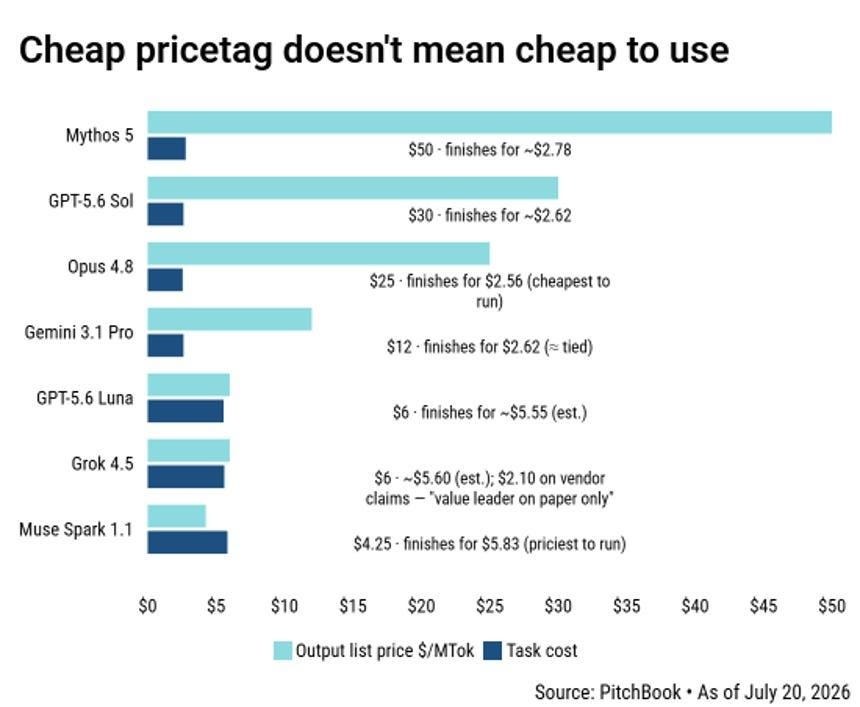
Smart buyers don’t measure the cost of tokens; they think about the cost per completed task.
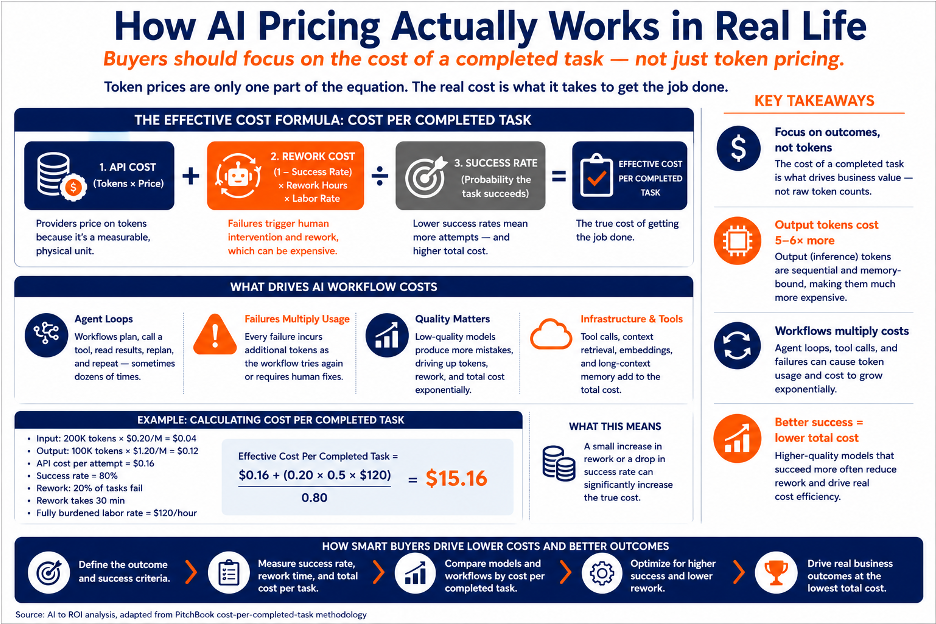
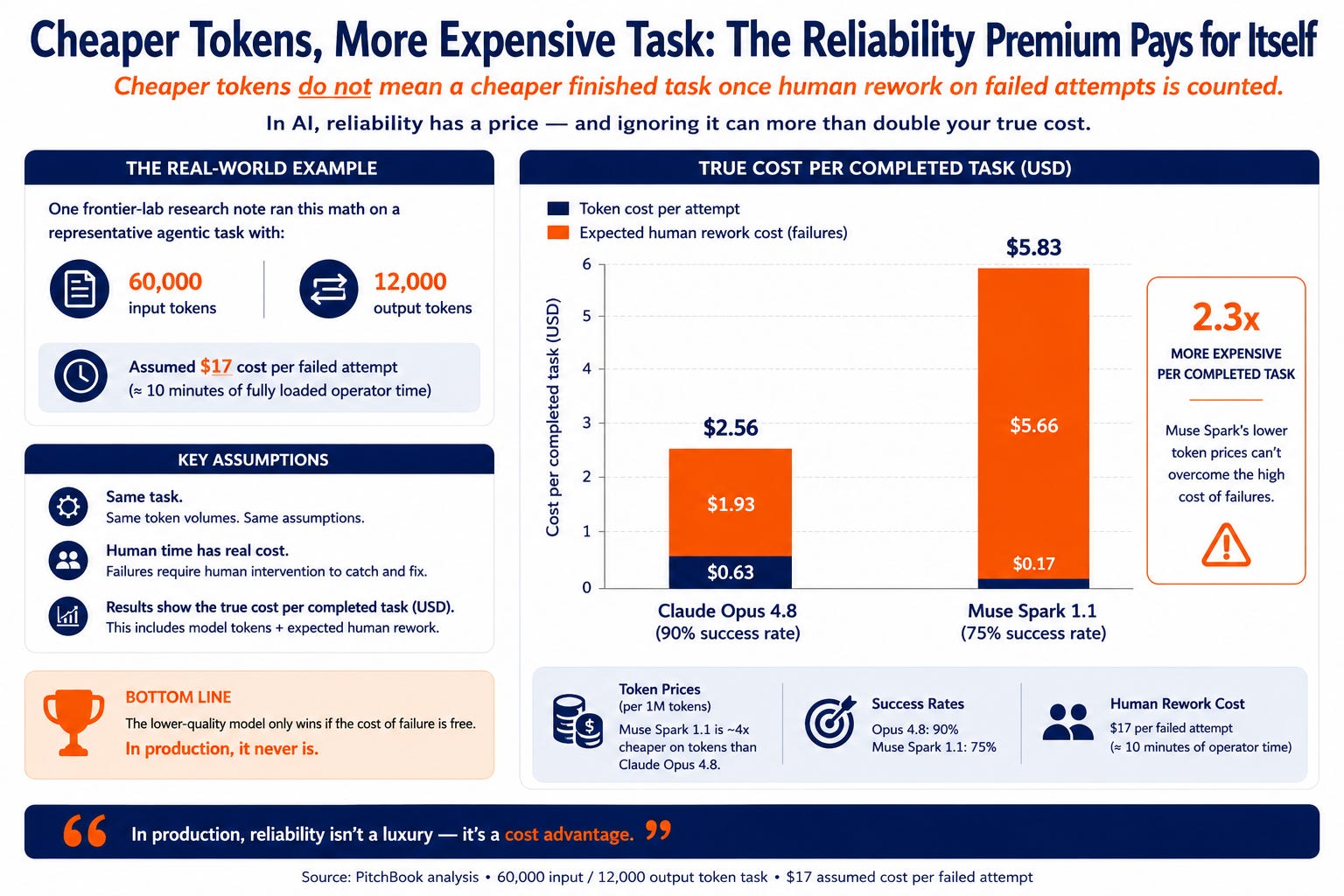
Here’s a usable approach for measuring the cost per completed task:
Take the API cost of one attempt – tokens in x input price + tokens out x output price
Add the probability of failure x the fully burdened cost of the human time it takes to catch and fix that failure
Then divide by the success rate
Here’s a real-world example:
One frontier lab ran exactly this math on a representative 60,000-input, 12,000-output-token agentic task.
The math assumed a $17 cost per failed attempt, about ten minutes of a fully loaded operator’s time.
Claude Opus 4.8 succeeded 90% of the time and finished the task for about $2.56.
Meta’s Muse Spark succeeded 75% of the time, finishing the same task for about $5.83, more than double Claude Opus’s cost, despite pricing tokens at a quarter of Opus’s rate.
The lower-quality model only wins if the cost of failure is zero, which is almost never true in production environments.
A Word About Kimi K3
Kimi K3’s release sent shockwaves through the AI industry and financial markets for one simple reason: It nearly equaled the performance of the top closed-weight models from US AI labs at a fraction of the cost. However, there are some caveats:
It’s early. The model has been public for 11 days. Its actual weights are being released today. There are no published large-scale use cases yet.
Early benchmarks show that Kimi K3 is a hungry model – eating 2-3x as many tokens to complete complex tasks and taking more tries to succeed.
Kimi K3 isn’t really built to serve smaller enterprises. In fact, hyperscalers, not open-weight model makers like Moonshot AI, could be the big winners. Per Exponential View:
The weights alone occupy 1.4 TB. It needs to be served on something like a 72-GPU NVIDIA GB200 NVL72 rack or equivalent. That’ll cost $3-4 million to buy and install. Operating it consumes about 120 kW continuously, over a million kWh per year, before you consider networking, storage, cooling, and humans. If you rented these in the open market, it would cost about $7 million a year.
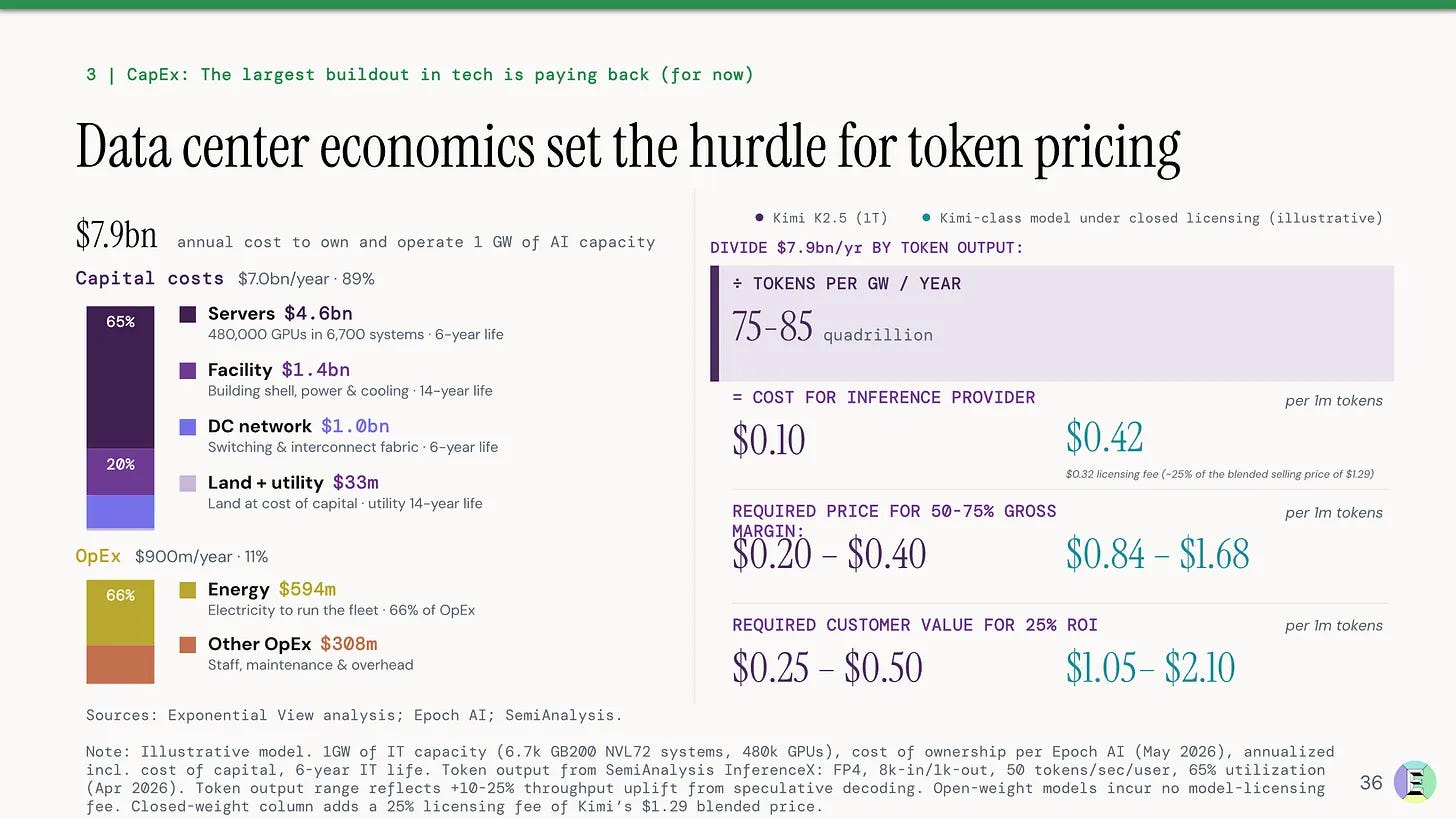
But for infrastructure providers, the economics of hosting open-source models can be very attractive compared to serving closed-source models. A simple way to understand this is to think of the hyperscaler as needing to pay a license fee for a closed-source model but not for an open-source one.
This means that a 25% license fee (or margin for a frontier lab) now sits with the hyperscaler, partly to pocket as revenue and partly to present an attractive price to the customer.
Benchmarking the Gap Between Price List and the Real Cost
Token-price comparisons are easy to find and mostly useless on their own. A few resources measure what matters.
LMSYS Chatbot Arena ranks models on head-to-head human preference, a reasonable proxy for perceived quality, but it says nothing about task completion or cost.
The UK AI Safety Institute’s Inspect framework and open-source evaluators like DeepEval let a team run its own workload against multiple models and measure success rate directly, which is the number the cost-per-task formula needs.
Databricks published its own internal benchmark on a multi-million-line codebase in July 2026, comparing coding agents on real engineering work rather than synthetic tests.
Cursor ran a related comparison on agent swarms, and found that better coordination across smaller models delivered comparable code quality at a fraction of the token cost of one large model performing every task. Neither replaces running your own workload through the formula above.
Three Use Cases, One Pattern
Agentic Coding
This is the use case Cursor’s own comparison addresses directly:
Better agent orchestration, not a bigger single model, delivered comparable output at a fraction of the cost, which means the model-selection question matters less than the orchestration question for this workload.
Complex Document Extraction
This is where the Opus-versus-Muse-Spark math above applies most directly:
A 15-point reliability edge justifies the premium model whenever a single failure costs more than about $2.24, and production failure costs typically run well above $10.
Extraction work that feeds a filing, a contract, or a regulator sits squarely in that zone.
Customer Support
Customer support is the most failure-tolerant of the three. A wrong answer rarely reaches a regulator or a legal filing, so the human-rework term in the formula stays small regardless of which model handles the ticket. This is where the cheap tier’s real advantage shows up, not in coding or extraction.
The Lesson
Reliability-gated work justifies the premium tier, failure-tolerant volume work does not, and the mistake enterprises keep making is picking one model to cover both.
What This Means to Enterprise AI Model Buyers
The pricing headlines are a distraction. Finance, IT and GTM teams should anchor on cost per completed task, not cost per million tokens. A model that prices tokens at a quarter of the premium rate but fails 15 to 25 percent more often can cost you more once you load in the human time to catch and fix each failure.
Here is one approach to operationalize this in your AI model decisions:
Build the cost per completed task into procurement. Take the API cost of one attempt, add the failure probability times the fully burdened cost of human rework, then divide by the success rate. Make vendors compete on that number, not on their price list. The formula turns a squishy “quality” debate into a CFO-legible unit economic.
Segment your workloads by failure cost before you pick a model. Reliability-gated work (extraction that feeds a filing, a contract, or a regulator) justifies the premium tier because a single failure costs well above the breakeven point. Failure-tolerant, high-volume work (most customer support) is where the cheaper tier actually makes economic sense. One recurring enterprise mistake is to standardize on a single model to cover both.
Solve the orchestration question, not just the model question. For agentic coding and similar workflows, better coordination among smaller models delivered comparable output at a fraction of the token cost of routing everything through a single large model. Model selection is one lever. Workflow design is often the bigger one.
Run your own evaluation. Public preference rankings tell you nothing about task completion or cost on your workload. Use an internal benchmark on representative tasks to measure actual success rates, then feed those into the cost-per-task math.
Do not over-rotate on the open-weight scare. Open-weight economics favor hyperscalers, not necessarily your P&L, and total serving costs (chips, power, cooling, people) do not disappear when the weights are free. Closed-weight prices are also still declining. Reliability, contracted infrastructure, and vendor durability belong in the evaluation alongside token price.
The bottom line for operators: the buyers who win here are the ones who match model tier to failure-cost workload by workload, measure completed tasks rather than tokens, and treat model selection as a portfolio decision rather than a single standardization bet.
The Takeaways
The release of Kimi K3 freaked out the entire US AI market, investors, and the US government; however, that doesn’t mean that open-weight model builders are the sure winners. Here are the factors that really matter:
Real-world performance. So far, closed-weight models from Anthropic, OpenAI, and Google have proven to be both higher-performance and more reliable. Prices on closed-weight models will also continue to decline.
Even though open-weight models offer economics for hyperscalers, closed-weight model companies have a huge advantage in contracted infrastructure commitments and access to capital unavailable to Chinese open-weight AI companies.
AI geopolitics is a wildcard. The US government is considering an outright ban or sanctions on Chinese open-weight models, citing the practice of distilling US lab models to improve their products.
How to Contact Us
Contact us directly here with questions about the Big Book of AI Metrics, benchmarking data, podcast advertising, or newsletter partnerships.
The Big Book of AI Metrics
Download the Big Book here to access the tools you need to build a measurement framework that delivers high ROI AI use cases.
The AI to ROI Podcast
If you want to listen to the latest in AI in more detail, Ray and Peter break down our big AI story of the week on the AI to ROI podcast. We also interview leaders at AI product companies and mid- to large-sized enterprises about their challenges and successes in AI. Click here to listen or subscribe using your favorite podcasting app.